Payroll Software for Rwanda, Built for Compliance

For companies operating in Rwanda, payroll means navigating PAYE, RSSB pension, occupational hazards, the Maternity Leave Fund and medical cover — a time-consuming process exposed to compliance risk. Popay fixes that. Our cloud-based HR software automates PAYE calculations, RSSB remittances and every statutory deduction, so your teams can focus on growth, not firefighting.

Why payroll processing in Rwanda breaks most systems

Running payroll in Rwanda means juggling PAYE across four tax bands, RSSB pension contributions of 12% of gross pay (6% employer / 6% employee), a 2% occupational-hazards levy for employers, the 0.6% Maternity Leave Fund (0.3% each side), and medical cover — all reported to the Rwanda Revenue Authority (RRA) and the Rwanda Social Security Board (RSSB) on tight monthly deadlines.

And the rules keep moving. The RSSB pension rate doubled from 6% to 12% in 2025, and a further 2% increase is scheduled every year from 2027 until it reaches 20% in 2030. Most payroll systems weren’t built to track a rising contribution rate, a widening contribution base and a moving regulatory target.

Popay’s cloud-based payroll platform was. Every statutory deduction, every salary calculation, every regulatory update, automated and always current.

Dive into...

Your payroll roadmap in Rwanda

Rwanda has no effective national minimum wage: the legacy statutory rate   (RWF 100/day)    dates back decades, and the new rate authorised by the 2018 Labour Code is still pending a Ministerial Order. In practice, pay floors are set by sector, by individual contracts and by collective agreements. That makes accurate, contract-aware payroll configuration essential — there is no single number to fall back on, so every sector rule and CBA has to be tracked correctly.

Rwanda at a Glance

Capital
Kigali
Local Currency
Rwandan Franc (RWF, FRw)
Official Languages
Kinyarwanda, English, French, Swahili
Tax & Social-Security Authorities
RRA — Rwanda Revenue Authority · RSSB — Rwanda Social Security Board
Income Tax Year
1 January → 31 December (calendar year)
Payroll Cycle
Monthly
Ordinary Working Week
45 hours (typically 8–9 h/day)
Notice Period
15 days (under 1 year of service) · 30 days (1 year or more)
Working / Retirement Age
16 years / 60 years
Main Labour Law
Law N° 66/2018 of 30/08/2018 regulating labour in Rwanda
Monthly Statutory Deadline
PAYE to the RRA by the 15th · RSSB pension, occupational hazards & maternity by the 15th · RAMA medical scheme by the 10th
Minimum Wage
No effective national rate — legacy RWF 100/day; new rate under the 2018 Labour Code pending a Ministerial Order.

Pay floors are set by sector, by contract and by collective agreement.

Want to learn more?

Your dedicated Popay contact
Your direct link to Popay

Years of experience
+
Employees
0 +
Clients
0 +
Countries
0 +

Automated tax calculations, statutory deductions & social security remittance

This is where most payroll processing breaks down. Employers in Rwanda must register and remit to multiple statutory bodies: RSSB for pension (12% of gross pay, split 6% employer / 6% employee), occupational hazards (2%, employer only), the Maternity Leave Fund (0.6%, split 0.3% each), medical cover via RAMA/RSSB or a private scheme, and monthly PAYE to the Rwanda Revenue Authority (RRA). PAYE is due by the 15th of the following month. Miss a deadline and penalties plus interest stack up fast. Popay’s payroll platform handles every salary calculation and statutory deduction automatically. No spreadsheets, no missed deadlines.

Statutory Contributions in Rwanda
RSSB Pension
Employer 6% + Employee 6% (12% total)

Of gross pay (basic + housing + transport). Doubled from 6% to 12% in 2025; a further 2%/year from 2027, reaching 20% by 2030.

Occupational Hazards
Employer only — 2%

Of gross salary (less transport). Managed by the RSSB; covers workplace injury and occupational disease.

Maternity Leave Fund
Employer 0.3% + Employee 0.3% (0.6% total)

Of gross salary (less transport). Funds the paid maternity-leave benefit; managed by the RSSB.

Medical Insurance (RAMA / RSSB)
Employer 7.5% + Employee 7.5% (15% total) — of basic salary

Mandatory for public institutions only. Private-sector employers affiliate voluntarily (minimum 7 employees, all salaried staff) or provide private medical cover / CBHI (Mutuelle de Santé) instead.

PAYE is withheld separately and paid to the RRA (see the PAYE table). RSSB pension, occupational hazards and maternity are filed monthly by the 15th of the following month; RAMA medical by the 10th. The 2025 reform widened the pension base to include housing and transport allowances. Source: RSSB, RRA.

Employment Contracts in Rwanda
Contract Types
Open-ended (permanent) · Fixed term · Written or verbal (written strongly advised)
Probation
3 months, extendable once by a further 3 months after a written performance evaluation (6 months maximum)
Notice — Under 1 Year
15 days
Notice — 1 Year or More
30 days. Salary in lieu of notice if the employer requires an immediate exit.
Working Hours & Overtime
45 hours/week (8–9 h/day); overtime at 1.5× the regular hourly rate
Working / Retirement Age
16 years / 60 years
Severance Pay
Mandatory for non-misconduct terminations after 1+ year of service: 2 months (1–5 yrs) · 3 months (5–10) · 4 months (10–15) · 5 months (15–20) · 6 months (20–25) · 7 months (25+)

Calculated on the average gross salary of the last 12 months (excluding tools provided for the job).

This statutory « termination allowance » is owed for « ordinary » terminations (e.g. downsizing, poor performance) — not for dismissal for misconduct. Source: Articles 31 & 32, Law N° 66/2018 of 30/08/2018 regulating labour in Rwanda.

Want to learn more?

Don’t wait: book a meeting with our Rwanda HR specialist now. They will guide you, answer all your questions, and help clarify your HR obligations in Rwanda.

Your Rwandan payroll processing, mastered from A to Z.

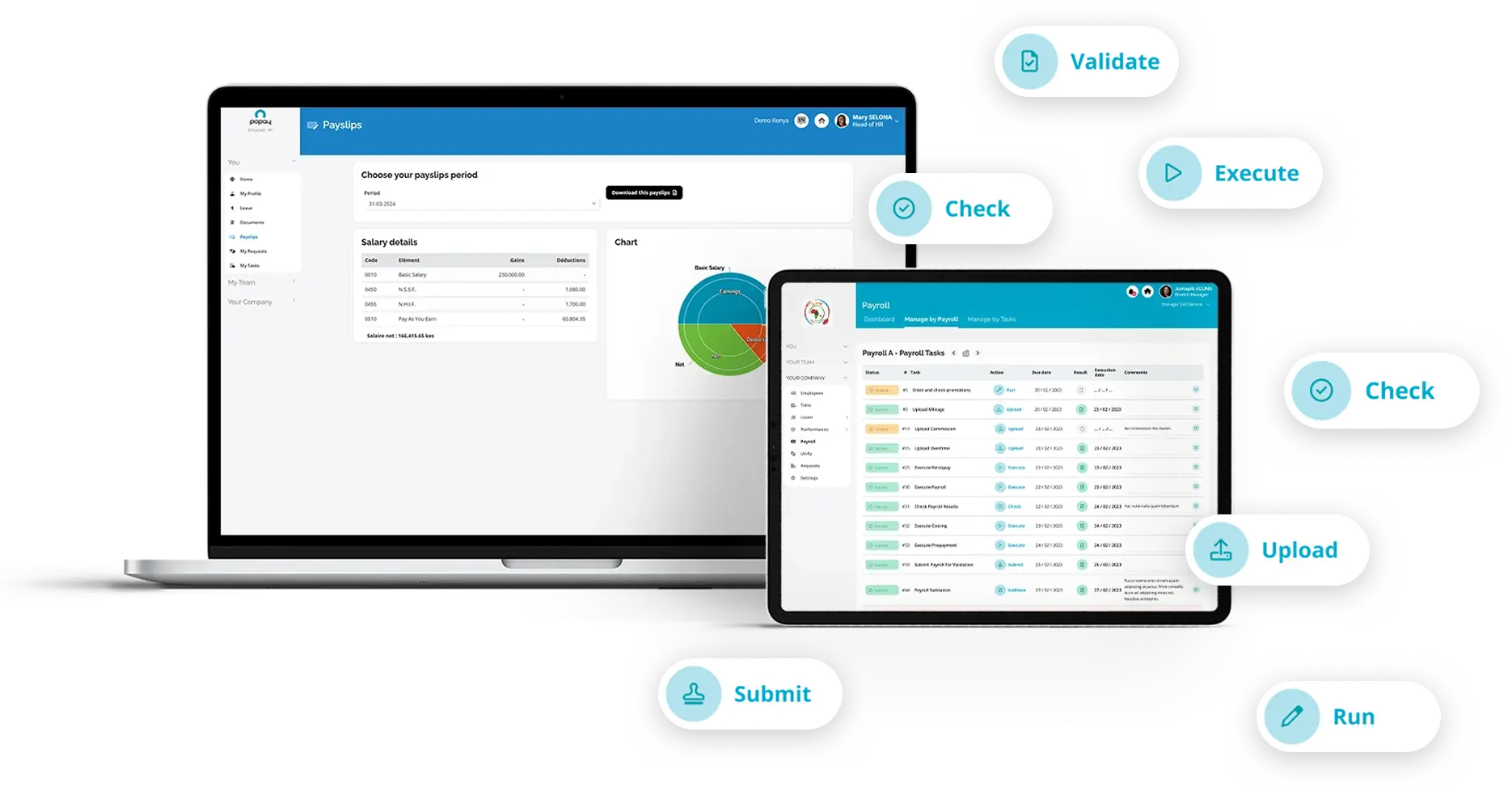
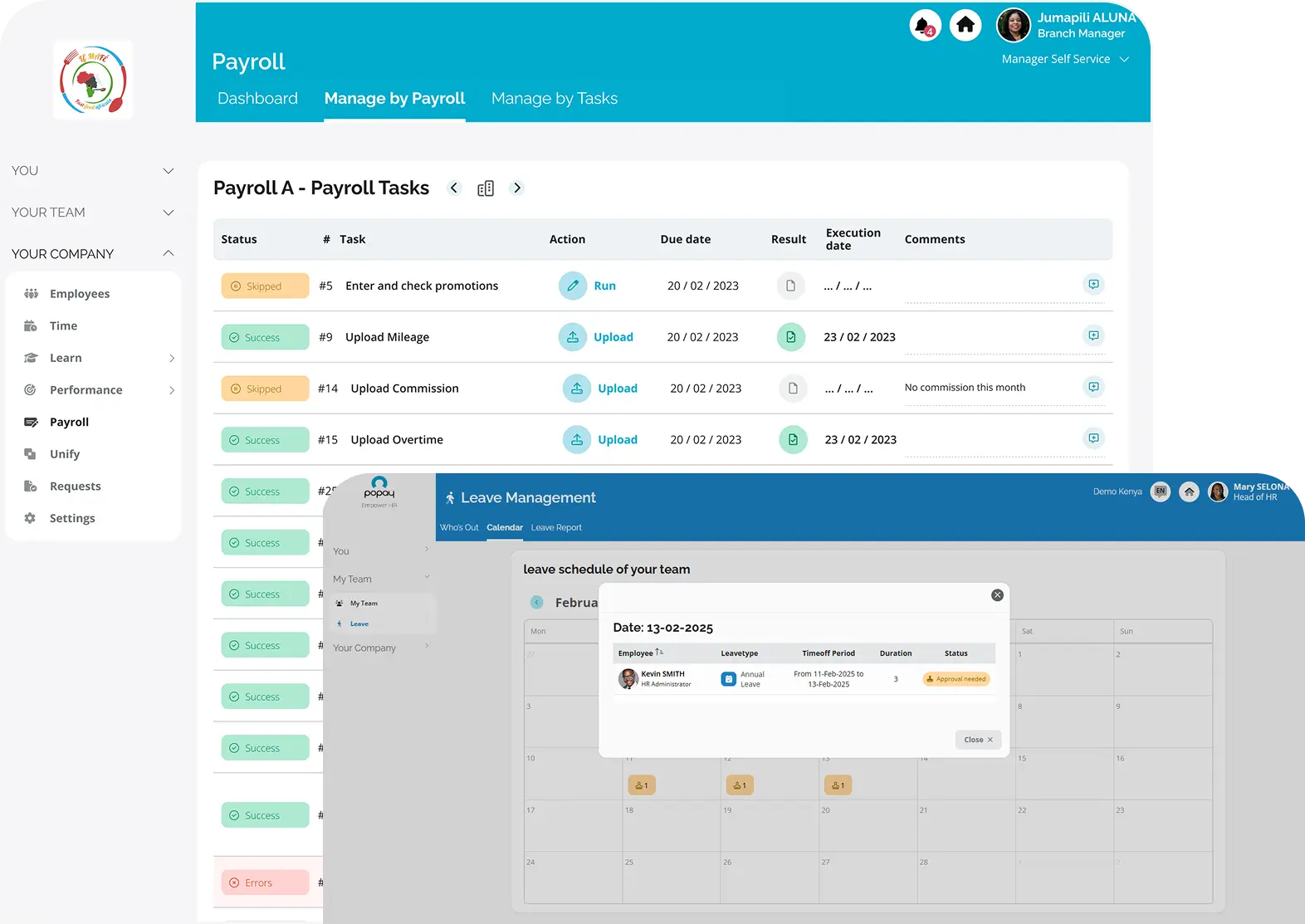
Popay’s cloud-based payroll system automates everything: compliant payslips, PAYE calculations, RSSB pension and occupational-hazards remittances, Maternity Leave Fund filing, direct deposit to employee bank accounts, and full compliance with the Law regulating labour in Rwanda. Integration with your existing HRIS, ERP, and performance management tools comes built-in. Employee self-service portal for payslips, leave requests, and tax certificates.

Employment contracts & onboarding compliance

Law N° 66/2018 of 30/08/2018 regulating labour in Rwanda governs employment contracts, and getting onboarding wrong creates compliance risk from day one. Contracts can be open-ended (permanent) or fixed-term, written or verbal, with written contracts strongly advised so the key terms are unambiguous. Probation runs for 3 months and may be extended once by a further 3 months, subject to a written performance evaluation. Notice on termination is 15 days for under one year of service and 30 days beyond it, and where the employer wants an immediate exit, salary in lieu of notice must be paid. Your employee management software should auto-generate compliant contracts with all mandatory clauses. Popay’s HR software manages every category and tracks every contractual obligation.

Employment Contracts in Rwanda
Contract Types
Open-ended (permanent) · Fixed term · Written or verbal (written strongly advised)
Probation
3 months, extendable once by a further 3 months after a written performance evaluation (6 months maximum)
Notice — Under 1 Year
15 days
Notice — 1 Year or More
30 days. Salary in lieu of notice if the employer requires an immediate exit.
Working Hours & Overtime
45 hours/week (8–9 h/day); overtime at 1.5× the regular hourly rate
Working / Retirement Age
16 years / 60 years
Severance Pay
Mandatory for non-misconduct terminations after 1+ year of service: 2 months (1–5 yrs) · 3 months (5–10) · 4 months (10–15) · 5 months (15–20) · 6 months (20–25) · 7 months (25+)

Calculated on the average gross salary of the last 12 months (excluding tools provided for the job).

This statutory « termination allowance » is owed for « ordinary » terminations (e.g. downsizing, poor performance) — not for dismissal for misconduct. Source: Articles 31 & 32, Law N° 66/2018 of 30/08/2018 regulating labour in Rwanda.

Present across Africa and 35+ countries

We are proud to be the reference HR partner across Africa. Thanks to our local expertise and digital tools, we simplify HR management and legal compliance for every subsidiary.

Regions covered : South Africa, Zimbabwe, Ghana, Kenya, Ivory Coast, Senegal, Morocco, Tunisia, Egypt, etc.

Would you like to discover all the countries supported by Popay?

🌍
Our page is coming soon

We are currently building dedicated country pages to better serve you.
In the meantime, feel free to reach out to Jacob Louis for any questions about payroll & HR solutions in .

Chat with Jacob Louis on WhatsApp

Popay recognised among the top HR providers in Africa!

For the third consecutive year, Popay has been featured in the prestigious Everest Group Peak Matrix. A true mark of trust and recognition of strong local expertise across the continent.

Leave management & employee rights in Rwanda

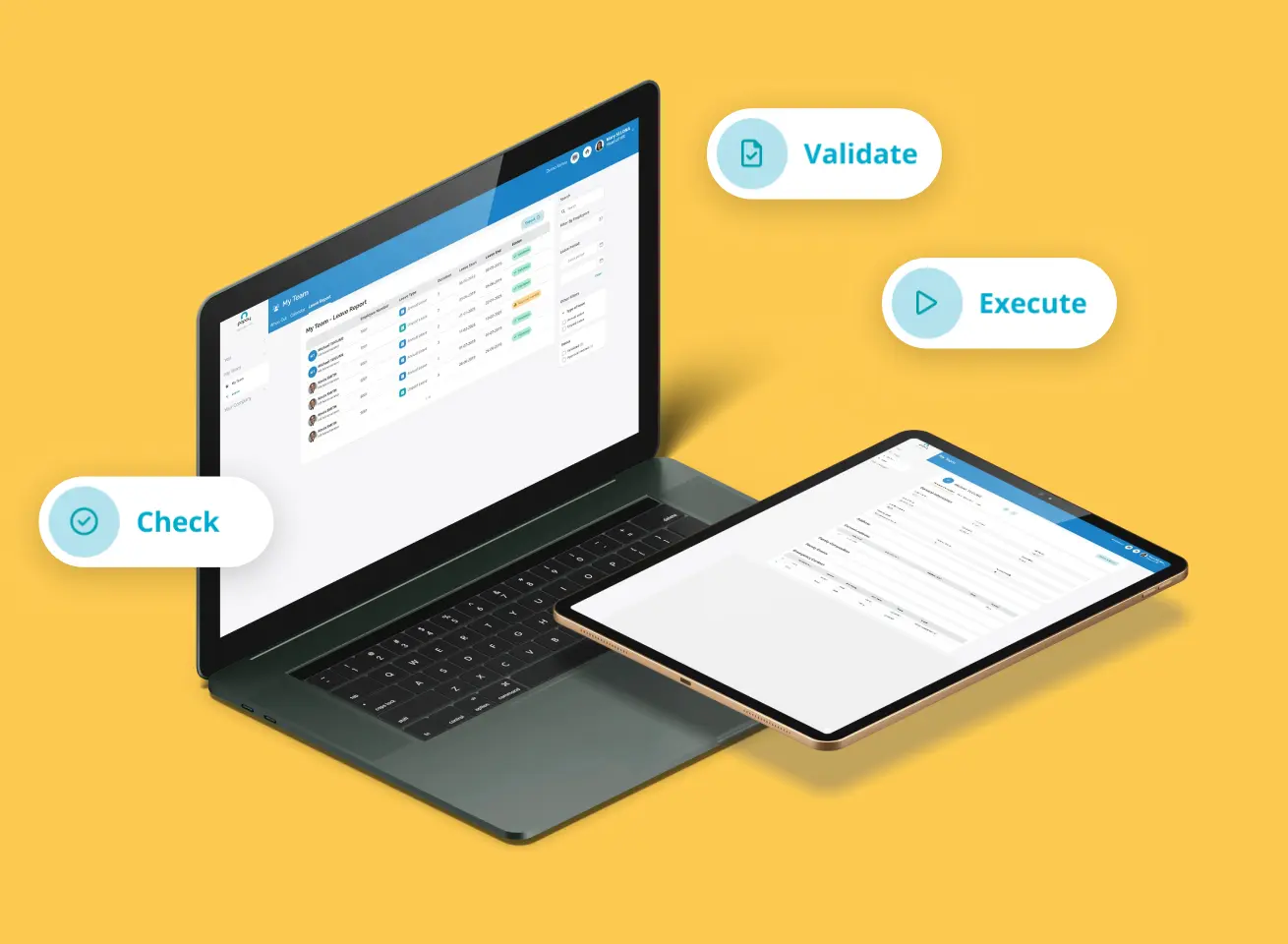
Leave management is where compliance gets personal. The Law regulating labour in Rwanda guarantees statutory minimums for annual leave (18 days, rising with seniority), maternity leave (14 weeks, fully paid), paternity leave, a long sick-leave cycle and a set of paid compassionate leaves for life events, but many companies offer more generous terms through contracts or collective agreements. Your payroll solution needs to track every entitlement, calculate accruals accurately, and give employees self-service access to their leave balances. Popay’s employee self-service portal handles this automatically, with real-time reporting and analytics for HR teams.

Types of Leave in Rwanda
Annual Leave
1.5 working days per month (18 days/year)

On full pay. Increases by 1 day for every 3 years of service, capped at 21 days.

Sick Leave
Up to 6 months in total

First 3 months on full pay, next 3 months unpaid. Medical certificate required.

Paternity Leave
4 working days, fully paid

Taken on the delivery of the employee’s wife.

Maternity Leave
14 weeks, fully paid

Employee must have at least 1 month of RSSB contributions. The employer pays the full 14 weeks, then claims 8 weeks back from the RSSB Maternity Leave Fund (claim within 6 months of the end of the leave). One additional month of paid leave in case of complications.

Compassionate Leave
2 to 6 paid days per event

E.g. own civil wedding 2 days · death of spouse 6 · death of a child 3 · death of parent/sibling 2 · death of in-law 2 · work relocation 2. Taken at the time of the event; cannot be carried over.

Statutory minimums under the Law regulating labour in Rwanda. Maternity leave was extended from 12 to 14 weeks by Law N° 049/2024 (Official Gazette, special edition of 11/06/2024). Source: Law N° 66/2018; Law N° 049/2024; RSSB.

Free demo

In 30 minutes, see how Popay's payroll software handles your Rwandan payroll processing: with reporting and analytics dashboards built for HR teams and CFOs.

Labour unions, collective agreements & what your payroll system must handle

Rwanda’s organised labour is led by three federations: CESTRAR (the oldest and largest, with around 16 affiliated unions), COTRAF and COSYLI. Their affiliated unions negotiate wages, allowances (housing, transport), overtime premiums, and benefits that your payroll software must calculate correctly — and union dues you must deduct and remit. Getting a collective agreement wrong doesn’t just mean a payslip error, it can mean a dispute before the labour inspector or the courts. Popay’s HR management platform maps every sectoral rule to your payroll configuration.

Key Labour Unions & Sectors in Rwanda
CESTRAR
Largest & oldest confederation — ~16 affiliated unions across most sectors

Bulk of national membership; negotiates the majority of sector wage scales and dues stop orders.

COTRAF
Congress of Labour and Fraternity — ~7 affiliated unions

Sector collective agreements (e.g. tea / SORWATHE); dues deductions.

COSYLI
National Council of Free Trade Unions — ~9 affiliated unions

Services & commerce wage scales; dues stop orders.

Governed by Law N° 66/2018 regulating labour in Rwanda. Around 19 collective agreements nationally set wages, allowances and dues. Disputes go first to the labour inspector for conciliation, then to the courts; the National Labour Council is the tripartite consultative body. Source: ILO; ITUC-Africa; CESTRAR.

Every employer must issue payslips compliant with the Law regulating labour in Rwanda, including all mandatory information (position, salary, overtime, statutory deductions, net pay, allowances). Your payroll software should generate these automatically. Employment records must be kept available for inspection. A cloud-based system with digital archiving makes this effortless.

PAYE must be remitted by the 15th of the following month to the Rwanda Revenue Authority (RRA). RSSB pension, occupational hazards and maternity contributions are due by the 15th of the following month, while contributions to the RAMA medical scheme are due by the 10th. Standard working hours are 45 per week, with overtime paid at 1.5x the regular hourly rate. Your attendance tracking system must log hours accurately for overtime calculations. Identify and apply the correct collective agreement for your sector. A scalable payroll platform like Popay handles all of this from a single dashboard.

Tax and labour laws are evolving. Is your payroll system keeping up?

Rwanda's RSSB pension contribution doubled to 12% in 2025 and is set to rise by 2% a year from 2027, reaching 20% by 2030 — and the contribution base now includes basic salary plus housing and transport allowances. The RRA and RSSB are pushing e-filing and digital compliance hard. If your payroll software wasn't updated, every payslip issued since may be non-compliant. Late PAYE remittance to the RRA triggers penalties and interest on the unpaid amount.

Popay helps you anticipate and adapt with:

Kigali
Popay HR specialist ready to help with payroll and HR compliance in Rwanda

Ready to run compliant payroll in Rwanda?

Book 30 minutes with our Rwanda HR specialist. We’ll walk you through the platform, the integrations and your compliance obligations — human, local and reactive.

Discover Popay’s full Africa coverage →